Fear of Criticism: When the Oslo Police Fear the Mirror of Journalism
A series of critical readings on the Oslo Police system and its institutional contexts, drawing on international and local reports and independent sources.
Part 5
Editorial
04.02.2026


In the official self image of the Oslo Police, fear of criticism does not appear as a temporary sensitivity or a passing media concern. Rather, it functions as an institutional condition that shapes behavior whenever scrutiny approaches structural failures or sensitive internal files. This is not merely anxiety over public embarrassment, but a documented pattern of resistance to independent narratives when criticism threatens areas the Oslo Police treat as shielded from accountability.
A report issued by Norway’s official Police Evaluation Committee, following a series of internal scandals, explicitly highlighted weak oversight mechanisms and a recurring reluctance within police leadership to address errors transparently particularly when criticism originates outside the police institution, from independent journalists or researchers not embedded within official structures. This reluctance was not procedural, but institutional, reflecting concern over losing control of public framing rather than correcting misconduct.
This pattern became particularly visible in 2021, when a limited-circulation academic report titled “Corruption and Unethical Conduct in the Nordic Police Forces” was released. The report drew on official Norwegian findings following the Erik Jensen case, one of the most serious corruption scandals in the history of the Oslo Police, and examined structural corruption and oversight failures within Scandinavian law enforcement. Instead of being met with academic rebuttal or open institutional engagement, the report was subsequently removed from the website of the Nordic Research Council for Criminology raising serious questions about how criticism is handled once it reaches the core of police authority.
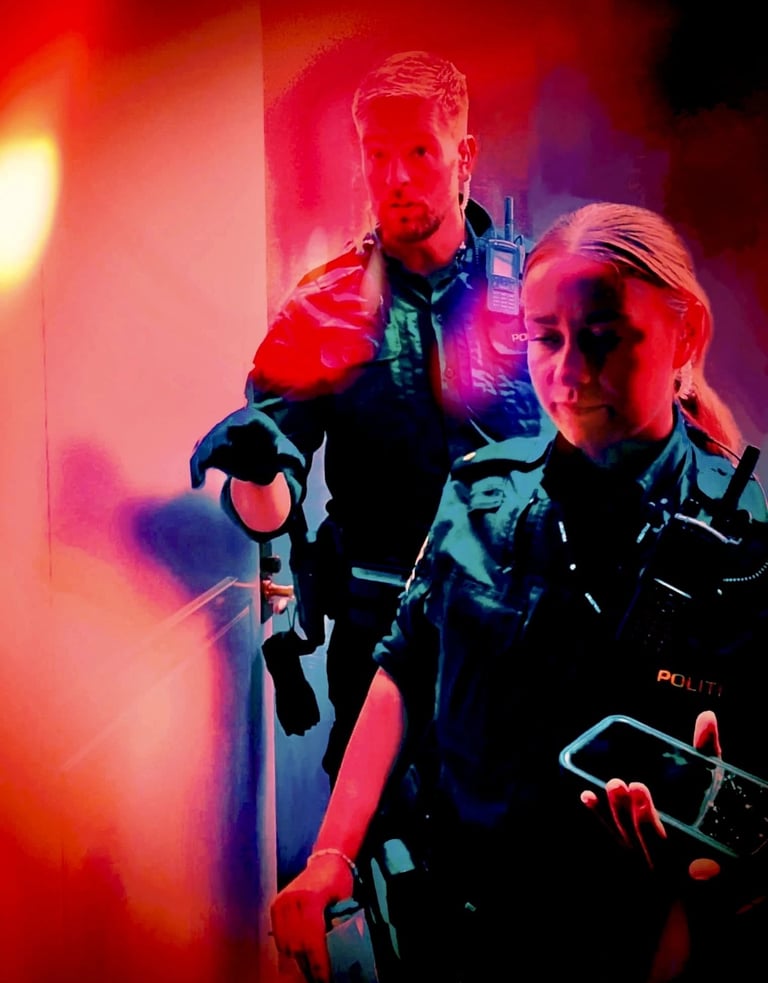

A snapshot from scenes in which the Oslo Police are accused of deploying their officers as instruments of intimidation against journalists, by staging unethical displays in front of neighbors practices said to be carried out under internal legal directives, as part of retaliatory efforts to deter publication. Conduct that raises serious questions about functional and ethical deviation and the abuse of authority outside the rule of law. This image is one of several documented photographs and video recordings cited as evidence of what journalists in Oslo describe as systematic and ongoing police intimidation by the Oslo Police in a retaliatory context.
The Oslo Police’s sensitivity to criticism does not stop at research or analysis. It takes more concerning forms when it extends into direct pressure on journalists. Independent accounts and publicly documented incidents describe sudden police visits to the homes of journalists or publishers shortly after the release of controversial investigations. These actions, carried out without clear judicial mandates, resemble displays of authority rather than lawful enforcement, signaling deterrence rather than accountability.
More critically, public resources have at times been deployed not for law enforcement, but for media damage control, the suppression of testimony, and the targeting of whistleblowers and victims as reputational risks to the institution. In such instances, the function of policing shifts from protecting rights to managing exposure.
Within this context, a documented case emerged in which a journalist was subjected to sustained pressure through the filing of strategic, retaliatory legal actions aimed at deterrence and the prevention of further publication. The pressure followed the journalist’s exposure of a scandal revealing severe vulnerabilities in the interaction between the Oslo Police and healthcare oversight bodies. The case pointed to unlawful cooperation between police actors and a physician implicated in documented legal violations, supported by public health officials operating with apparent immunity from accountability. The objective was not institutional correction, but forcing the removal of reporting that exposed a structure reliant on narrative control and misleading public imagery rather than transparency or lawful scrutiny.
Taken together, these incidents do not describe isolated errors. They point to an institutional posture within the Oslo Police that treats criticism not as a corrective mechanism, but as a threat to be contained. When a police authority begins to fear scrutiny more than misconduct, the issue ceases to be one of public relations and becomes a matter of legitimacy.


The Oslo police scene is an exaggerated visual display and does not reflect standard operations.
Sources:
Police Evaluation Committee Report (Norway)
https://www.politiet.no/globalassets/dokumenter-strategier-og-horinger/pod/rapporter/rapport-fra-evalueringsutvalget.pdfCorruption and Unethical Conduct in the Nordic Police Forces, it has been removed by the police, but you can download it.
Oslo Healthcare Oversight Failure (documented case)
https://helserett.com/en/oslo-healthcare-oversight-failurePublic testimony on police intimidation (Oslo)
https://www.reddit.com/r/oslo/comments/ylt0g2/so_a_swat_team_showed_up_at_my_door/
© Helserett i Oslo 2026