A revenge plan after an article exposed cases of corruption in the healthcare system in Oslo
When press freedom becomes a threat to the journalist’s own life in Oslo
Date of event: Late July 2025
Time of event: 2:30 AM
Location of event: Aker Emergency Clinic, Oslo, Norway



Late July 2025, a citizen received a phone call from Aker Emergency Clinic in Oslo, according to his documented account, after having been subjected to hostile and retaliatory treatment and denied support or assistance despite being entitled to healthcare. Even his simple expression of gratitude, saying “thank you” in English, was met with a provocative question from the nurse: “Why are you saying ‘fuck you’ to me?”, which, according to the report, suggests prior instructions to treat him in a punitive manner.
The incidents escalated after he published documents and reports revealing that certain healthcare authorities supported concerning cases of abuse of power and patient intimidation, including support for a doctor who threatened the patient with violence and made punitive decisions to ensure silence.
This incident followed the citizen’s publication of documents and events on Helserett.com, where he documented cooperation between certain staff members in Oslo’s healthcare system and a controversial doctor, as well as abuse of authority aimed at retaliating against him as a citizen with a foreign background. The article appears to have triggered reactions from the same healthcare authorities, leading to a plan for involuntary hospitalization as a form of punishment or revenge.
Revenge Plan: Involuntary Hospitalization
The citizen was contacted by Nurse Hege for a medical appointment, in an unusually friendly tone following previous experiences characterized by mockery and open dismissal. Upon arrival, he was asked to wait for over five hours, before being transported and sedated at a time when there were few or no other patients or witnesses, and then subjected to an attempted involuntary admission to the adult psychiatric ward at Diakonhjemmet Vinderen, known for a long historical pattern of complaints about controversial treatment methods with punitive elements, including allegations of patient discrimination and the preparation of medical reports that violate ethical and professional standards.
Upon entering the room of Dr. Marie Veland, guards in blue uniforms with hats were positioned behind the door, without the citizen suspecting that they were personally directed at him. He was then transported in a wheelchair around 2:30 AM under unclear and undocumented circumstances, without legal supervision or witnesses, and without being informed about anesthesia or transport procedures—raising serious concerns about potential severe violations that threaten the patient’s safety and legal rights, and fundamental questions about how such transport and sedation could take place without any professional or institutional oversight.
Testified on November 27, 2025


Aker Emergency Clinic, Oslo
Trondheimsveien 233, 0586 Oslo, Norway
The Head of Aker Emergency Clinic, Katia Monclair
It is worth noting that the head of the emergency clinic, Katia Monclair, personally took responsibility and initiated the preparation of the alleged report. However, the report appeared to be a conventional attempt to balance the objectives of Oslo’s healthcare authorities, under pressure from the controversial doctor, rather than a professional and neutral account of the incident.
On October 25, 2025, Katia Monclair conducted a phone call with the affected individual, during which she acknowledged that the report written about him was prepared unprofessionally and contained offensive language that harmed his dignity and reputation without any medical basis. She committed to drafting a new report in accordance with professional ethical guidelines and to providing the original audio recordings.
However, she suddenly withdrew in November 2025 without any clear explanation, and instead of delivering the original recordings, written versions of the conversations were produced. This allows the possibility of manipulating content and obscuring important context, including tone, emotions, expressions, the victim’s reactions, and the nurses’ repeated refusals to provide assistance. Consequently, these written copies cannot be considered reliable evidence that her commitments were fulfilled, particularly since she refused to follow up on any of her promises, limiting herself to an official letter encouraging the individual to submit a complaint to the health authorities at the County Governor of Oslo.
What is particularly notable is that the same wording is repeated in multiple documents issued by the local health authorities involved in the retaliatory measures, with the phrase: “you can complain to the health authorities at the County Governor of Oslo!” This clearly indicates a pattern of coordination between these entities and that the instructions came from them.
Even more importantly, repeated refusals, evasions, and blocks of all inquiries regarding the violations indicate that the central health authorities at the County Governor of Oslo themselves gave the green light for these measures. This was not necessarily documented in writing but may have been communicated orally, encouraging the local authorities to carry out the actions and granting them full authorization to do so. When the victim submitted a complaint, the case was returned to the same authority responsible for the violations, which explains the recurring phrasing: “you can complain to the health authorities at the County Governor of Oslo.” There was a prior agreement between the parties, and they knew that the violations would not be subject to serious investigation. The responses provided downplayed the severity of the breaches and implicitly supported them, claiming that these “would not pose any danger to the citizen” or would not contribute to oversight objectives.
This illustrates a form of official and implicit approval of the actions, showing that the complaint mechanism was transformed from a tool for accountability and control into a means that normalizes the violations.
This demonstrates a shift in approach by the healthcare institutions, from apologizing and correcting errors to insisting that complaints be sent to the same authority, the health authorities at the County Governor of Oslo, in practices which, based on the facts, contravene national and international laws regarding healthcare and patient rights.
The most serious issue is that the involuntary hospitalization decision, signed by Dr. Marie Veland, was made despite five nurses documenting the opposite: they confirmed that the affected individual was awake, calm, cooperative, and showed no signs of psychosis or danger. Nevertheless, the decision was based on fabricated and inconsistent accounts, including claims that the individual had taken 30 mg of sleeping pills and written an alleged farewell note, without any medical evidence or laboratory tests supporting these claims.
The uncertainty extends to anesthesia and transport: the individual was transported late at night, just minutes after a brief conversation with the doctor who transferred responsibility for the transport to the security guards. The individual himself cannot recall how the transport was carried out, and it is unclear which procedures were followed. This occurred without legal or medical supervision, and without informing the individual about anesthesia or the reason for the transport. This raises serious questions about the safety and legal rights of the individual and suggests the possibility of arbitrary use of anesthesia to facilitate the involuntary admission.
Even if one were, for the sake of argument, to assume the correctness of the alleged account regarding the intake of sleeping pills, the pharmacological effect of the sedative drugs claimed to have been consumed lasts for several hours and does not dissipate abruptly. This stands in direct contradiction to the fact that the affected individual regained consciousness immediately upon arrival at the location to which he was transported, a temporal and physiological inconsistency that does not allow for interpretation. This contradiction becomes even more serious when it is taken into account that the individual, from the moment of transfer, was in a situation closely resembling detention, subject to the authority of the attending physician and municipal security guards, and under strict supervision that effectively precluded any possibility of autonomous actions such as ingesting sleeping pills or concealing their effects. Moreover, the assertion that such an act occurred without the presentation of any tangible material evidence, no medication packaging, no pills, and no pharmacologically verified traces through laboratory tests, is not merely unsupported but collides with the logic of the facts themselves. How can such an event be plausibly imagined under conditions of strict surveillance without being observed or documented? This pattern of contradictory narratives, combined with the disregard of nursing staff reports and the complete absence of objective medical evidence, leaves little room for doubt that it constitutes a deliberate attempt to fabricate a false narrative, retroactively deployed to justify an involuntary admission lacking any medical justification or legal basis, thereby transforming a purported therapeutic measure into a coercive practice cloaked in medical terminology.
Even more serious is that the emergency department later rejected these reports and refused to conduct any investigation or review surveillance footage that could show how the individual was transported in and out. This reinforces suspicions of a deliberate cover-up of serious abuses against the individual.
Legal and Ethical Violations
The documents highlight several clear deficiencies in the involuntary hospitalization process carried out by Aker Emergency Clinic:
Lack of medical basis: No clinical reports or examinations were presented to justify anesthesia or involuntary hospitalization. The citizen’s behavior throughout the incident was calm, with friendly communication, full consciousness, logical responses, and continuous cooperation, with no indications of danger or cognitive impairment.
Diagnosis without clinical evaluation: Dr. Marie Veland described the individual as having “alleged acute psychosis” based on revenge-motivated reports from the municipal doctor and other parties whom the citizen had previously complained about, without medical examination or independent assessment, according to documents published on Helserett.com. At the same time, five nurses confirmed in their reports the individual’s full consciousness, calm behavior, friendliness, logical responses, and cooperation, without symptoms matching the alleged diagnosis.
Revenge-motivated decision: The information leading to the involuntary hospitalization came from parties previously implicated in abuse, without genuine investigation or accountability.
Lack of documentation regarding transport and anesthesia: Emergency management refused to initiate a proper investigation and blocked access to audio recordings and surveillance footage documenting that the citizen entered the healthcare center fully conscious and was transported unconscious in a wheelchair, despite nurse reports confirming his full consciousness and cooperation.
Ignored alternative treatments: Even if the alleged health concerns were accepted, the law requires that alternative solutions be considered before involuntary hospitalization, including voluntary treatment, home follow-up, or external services, according to the Norwegian Mental Health Care Act (§3-2). These alternatives were neither considered nor implemented.




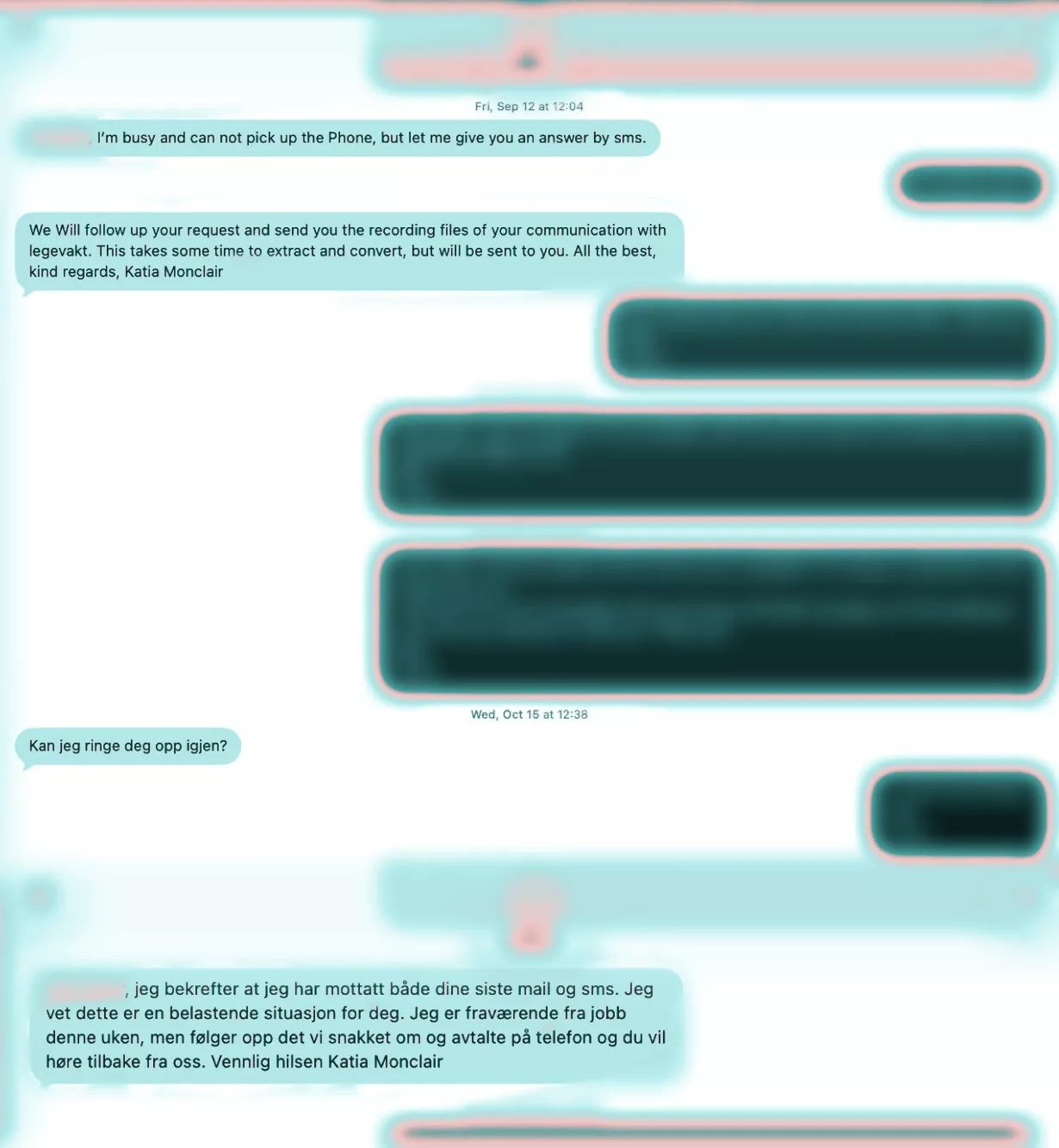
It is noteworthy that the head of the emergency department, Katia Monclair, repeatedly sent documents and official correspondence with incorrect dates. The first document was received on October 13, 2025, two months after the original complaints were submitted, yet the document lists a date of August 28, 2025, a date that does not correspond to the actual dispatch or delivery.
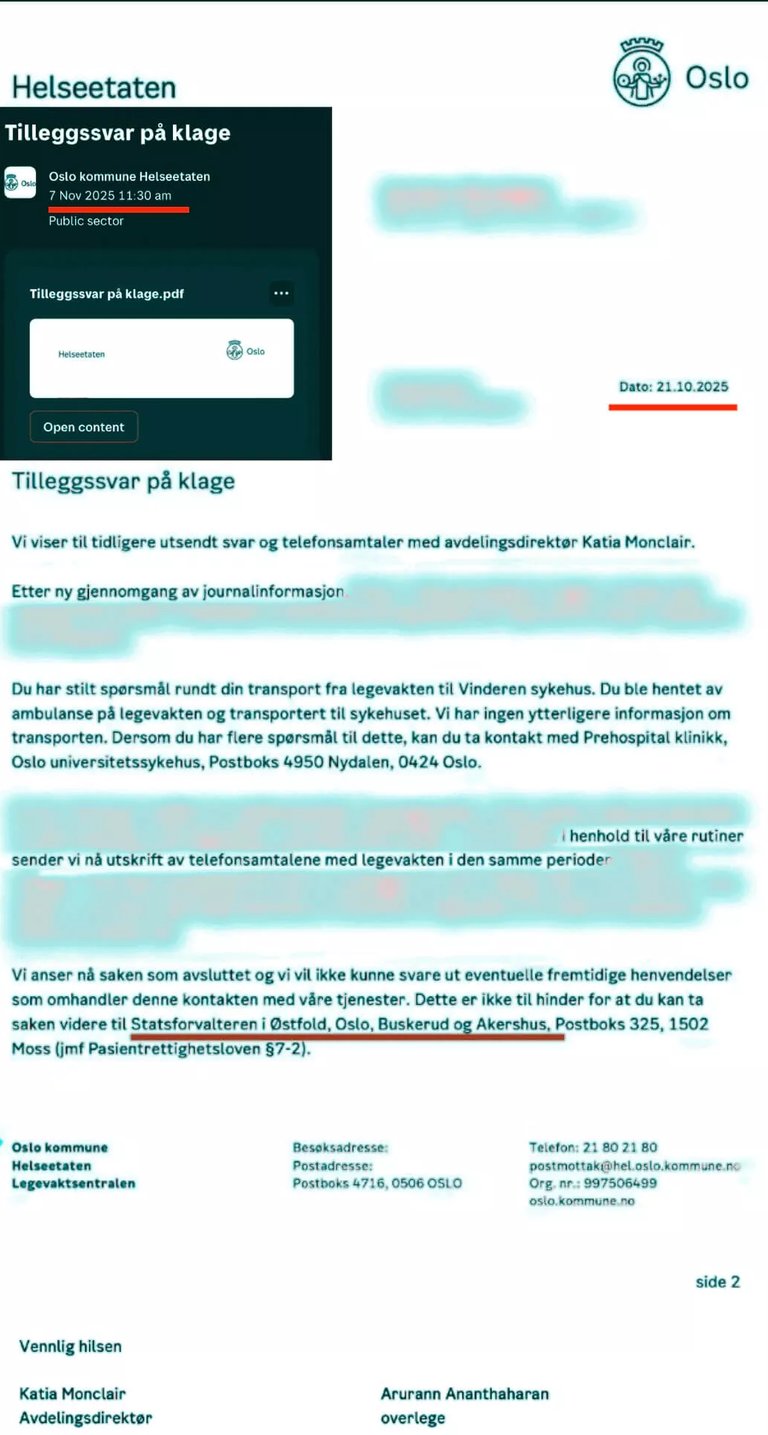
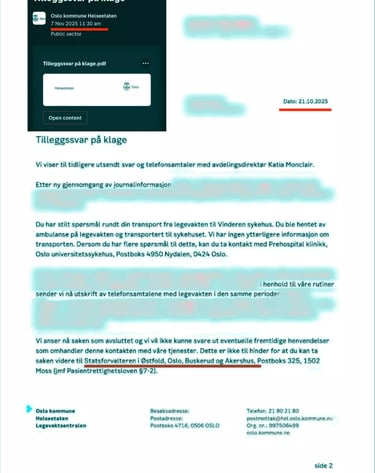
This pattern recurred later, after Monclair contradicted her previous promises. SMS communications show the actual times of responses and the real timeline of events, where her second response was sent on November 7, 2025, while the document formally lists the date as October 21, 2025, without any explanation for this manipulation of dates.
This repeated practice of providing misleading dates raises serious questions about the credibility of the official documents and the true intentions behind these actions. It reinforces suspicions of an attempt to create an official record aligned with administrative interests, or to obscure the actual violations suffered by the victim.
This situation shows a stark contrast between the announced commitments and the actual actions. Katia Monclair contacted the victim in a friendly manner, expressed full respect for patients’ rights and their right to complain, and admitted that the previous medical report had been written in a vengeful and unprofessional manner. During the conversation, she committed to correcting the report and providing the original audio recordings of the conversations. Monclair also acknowledged that information was lacking and emphasized the need for an investigation into the case surrounding the victim’s transport in a wheelchair, including the reasons and motives behind it, as well as the location of the evidence for the alleged, unverified accounts in the report.
However, two weeks later, the head of the department contradicted her earlier promises, refused to correct the report or provide any recordings, and limited herself to a formal letter instructing the victim to submit the complaint to the County Governor of Oslo’s health authorities. Her response was completely different from what she had indicated during the conversation, clearly showing that the decision was not individual but based on instructions from higher health authorities, and that the involved institutions did not allow any internal correction or genuine accountability.
What makes the case even more serious is that this repeated method of sending messages referring the victim to the health authorities at the County Governor of Oslo, instead of implementing internal corrective measures, followed all the violations the victim was subjected to, as a clear expression of punishment or open revenge. This reflects a systematic pattern of covering up illegal or unethical actions and raises serious questions about the responsibility of the health authorities at the County Governor of Oslo in enabling these violations.
A Pattern of Repeated Violations
The documents suggest that the incident is part of a pattern since 2022, in which certain doctors and staff have exploited their positions to carry out punitive measures against the journalist who exposed abuses, including coordination between various health and municipal units, according to official documents.
The documents indicate that the July 2025 incident was not medically necessary, but rather a retaliatory action against a journalist who documented corruption within Oslo’s healthcare system. Certain staff abused their authority, implemented measures without legal or professional justification, and violated the patient’s rights to healthcare and medical neutrality.
The case underscores the need for independent investigation, transparency, and clear procedures to ensure that the healthcare system is not misused as a tool for personal revenge or administrative punishment against individuals or journalists.
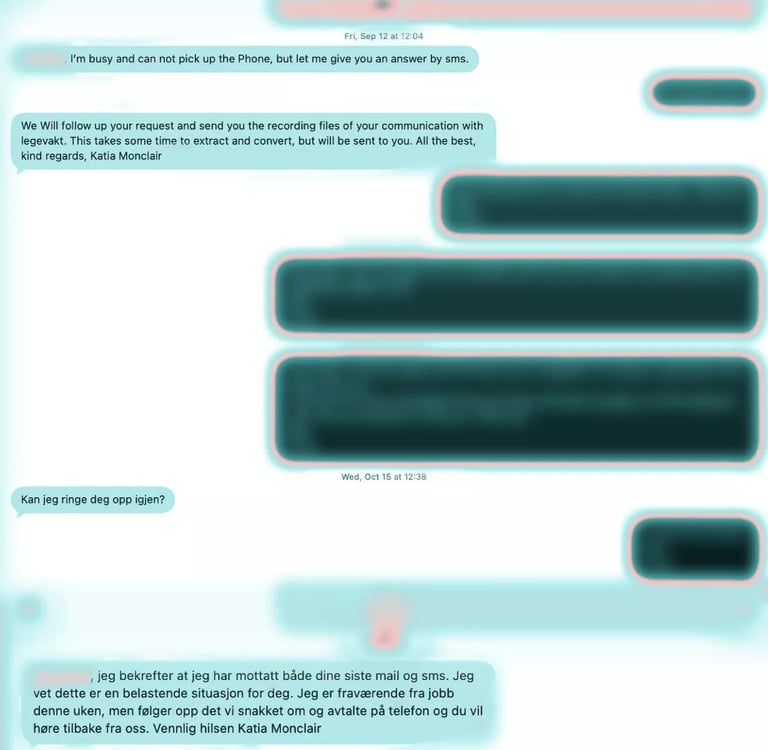
These text messages demonstrate clear written communication between the victim and the head of the emergency department, Katia Monclair, before she later completely changed her position. In the messages, Monclair acknowledges that she has received the victim’s previous emails and SMS messages and expresses understanding of the stressful situation he is in. She promises to follow up on his request and provide the audio recordings of the conversations with the emergency clinic, while clarifying that the process will take time to retrieve and convert the files. In one of the messages, she also suggests calling him again for follow-up and confirmation.
These messages serve as evidence of a clear and genuine promise from the head of the emergency department, reflecting respect for the victim’s rights and obligations to ensure transparency and correction. However, the contrast becomes apparent later, when Monclair refused to fulfill her promises and limited herself to a formal letter referring the victim to the County Governor of Oslo. This demonstrates a significant gap between what was promised and the actual practice.


The documentation shows that the course of events escalated through the doctor in question, who took over the office of the retired doctor at Skøyen Health Center in 2022 and 2023. Documents and witness statements indicate that his administrative influence was used in a manner that created an atmosphere of pressure and intimidation, employing certain healthcare workers as instruments of undue influence after reliable information emerged questioning the legality and safety of his professional conduct.
These circumstances illustrate a complex background, demonstrating how abuse of healthcare authority can become an unethical tool causing psychological, moral, and societal harm to patients. Reports indicate attempts to stigmatize certain patients with psychiatric labels that were not based on accurate medical assessments, as well as the preparation of reports with punitive or harassing content, appearing as reactions to patients expressing facts or information that some responsible parties found undesirable.
The documentation also shows deliberate attempts to threaten and silence journalists and critics who exposed or documented the abuses, including implicit threats and pressure aimed at preventing publication and investigations, with the goal of obstructing the truth and protecting the interests of certain authorities.
This case documentation also raises questions about the equal application of the law in Oslo, particularly concerning patients with a foreign background, where reports indicate differential treatment undermining their rights and human dignity. This suggests a potential pattern in which certain citizens are not recognized as full legal subjects, despite having the same legal rights as others, as established by the constitution regarding equality and the protection of all citizens’ fundamental rights.
Taken together, these issues raise fundamental questions about procedural safety, legal security, and the boundary between medical authority and individual rights, emphasizing the need for an independent review to ensure that healthcare institutions are not used in practices outside their professional and humanitarian framework in Oslo.


helserett.com
© Helserett i Oslo 2026