Oslo Police: Under the Light, A Critical Review of International and Local Reports
A series of critical readings on the Oslo Police system and its institutional contexts, drawing on international and local reports and independent sources.
Part 1
Editorial
02.02.2026 Norway


Within institutional discourse, the Oslo Police appear as the façade of law and order: a symbol of the capital’s security and a bastion for the protection of society. Yet when measured against the tools of reality, this façade becomes a distorted mirror of itself, an image fortified with official data, while justice on the ground either recedes or shifts color according to concealed interests. This series of critical readings does not build assumptions or analyses lacking evidentiary support; rather, it draws on international and local investigations, reports, and independent sources to demonstrate how justice is hollowed out at the level of executive practice, and how the law is administratively repurposed within the Oslo Police system when facts collide with influential interests in Oslo. In return, a polished institutional image is offered at the expense of serious accountability. Accordingly, this series does not claim the authority to issue verdicts; it exercises its editorial role without seeking permission from anyone, standing on argument and evidence, and casting light on areas deliberately kept in darkness within the Oslo police apparatus.
Internal Administration Between Structural Failure and Fatal Delay, Before and After 22 July 2011
When examining official sources and critical investigations into the performance of the Oslo Police before and after the 22 July 2011 attacks, a coherent picture emerges: the crisis was not confined to failures in field operations, but rooted more deeply in administrative structure and decision making culture. The report of the National Commission of Inquiry appointed to examine the events of 22 July commonly known as the Gjørv Report did not merely document the police’s failure to respond effectively to the Oslo government bombing and the Utøya massacre. It clearly identified core institutional deficiencies, including inadequate implementation of established procedures, weak inter unit communication, failure to activate existing contingency plans and crisis strategies, and delayed use of intelligence at the early warning stage.
According to the official report, reporting systems between regional units and senior command were operationally ineffective, despite having been formally adopted years earlier. This resulted in delays in disseminating a detailed description of the perpetrator and hindered coordinated emergency response, even when corroborated information existed regarding suspicious purchases that could be linked to the preparation of explosive devices months before the attack.
Critical documentation does not stop at operational shortcomings. Academic analyses have demonstrated that the internal work culture of the police itself suffered from the marginalization of strategic information management and organizational coordination. Day to day operational tasks dominated leadership resources, while planning, strategic intelligence gathering, and risk management were sidelined as core functions. This imbalance rendered the institution less capable of responding to highly complex crises and less able to learn systematically from prior failures.
What becomes evident when comparing the periods before and after 22 July is not merely a technical assessment of an isolated incident, but clear evidence of structural incapacity within leadership systems, emergency planning, and information flow across different departments of the Oslo Police. Moreover, detailed analyses of post-attack documentation indicate that the administrative reforms introduced did not address the roots of institutional culture. Instead, they largely focused on correcting procedural and formal deficiencies, rather than rebuilding the underlying mechanisms of response and institutional coordination.
Within this framework, it becomes necessary to read police Oslo performance in subsequent cases whether involving human trafficking or quasi-institutional affairs not as isolated events, but as part of a broader administrative context revealed by the 2011 crisis: a record oscillating between declared plans and the actual capacity to implement them within the internal administration.
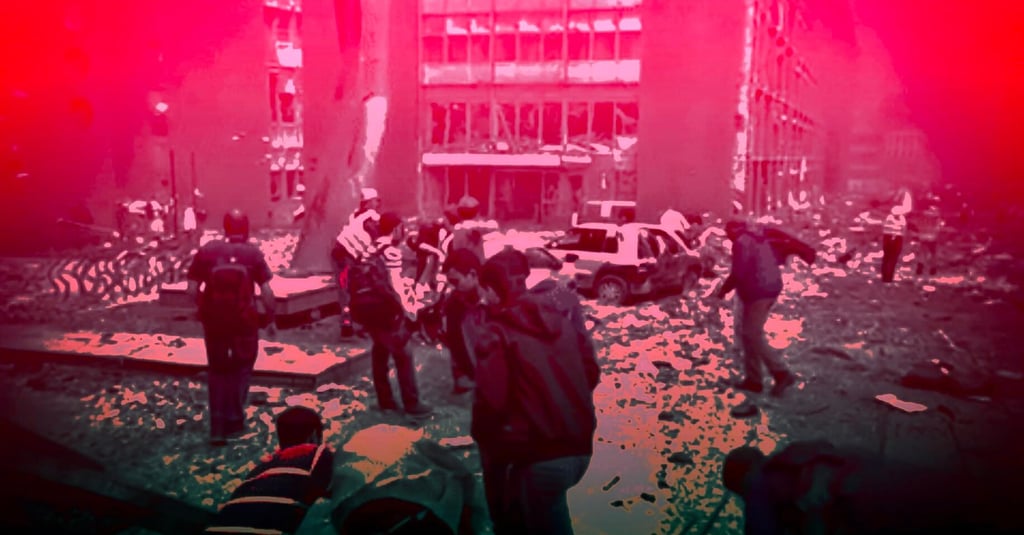
Oslo, July 22, 2011
A car bomb exploded near government offices, exposing a critical failure in police readiness and coordination. Communication broke down, command faltered، and the response lagged. As the attacker proceeded to Utøya, these shortcomings became impossible to deny revealing not just a security breach, but a systemic lapse in preparedness at a decisive moment.


An aerial view freezes a moment in time: the killer, expressionless and unhurried, stands amid lifeless bodies scattered across Utøya Island a haunting tableau of terror on July 22, 2011. As the murderer methodically hunted terrified teenagers, shooting them as they hid among rocks and trees.


Each soul lost stands as a silent testament to the tragic failure of the Oslo Police. In this grim chapter of Norway’s history, the contrast is stark: a ruthless killer moving freely among the defenseless, and the Oslo Police immobilized and ineffective, caught in a web of unpreparedness and confusion. The island, once a place of youth and hope, now stands as a somber reminder of a day when the thin line between safety and chaos was severed, leaving a nation to mourn the consequences.
© Helserett i Oslo 2026